
Army Modernization: Better Schedule and Cost Information Needed to Support Scaling Battlefield Network
Fast Facts
The Army has two efforts underway to modernize its mobile battlefield communication technologies, making them more reliable and secure for modern large-scale combat operations. The first effort is a near-term upgrade to eliminate large, immobile command posts that are easy to destroy.
The second effort is ongoing and should provide the Army with a long-term mobile network solution when complete. But the Army doesn't have detailed schedule or cost information for this effort. This increases the risk these technologies will not be given to all Army units by FY 2032, as tentatively planned.
Our recommendations address this issue.

Close up of the words "U.S. Army" on Army fatigues.
Highlights
What GAO Found
The Army’s two efforts to modernize its battlefield networks—the nearer-term Command and Control Fix (C2 Fix) and the longer-term Next Generation Command and Control (NGC2)—seek to make command and control more adaptive, survivable, and better suited for modern large-scale combat operations.
Representation of Evolution of Battlefield Network Through Next Generation Command and Control (NGC2)
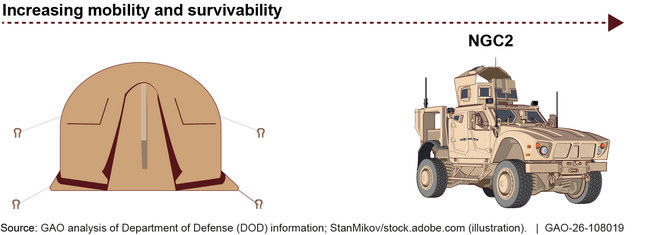
The Army’s approach to developing C2 Fix and NGC2 incorporates some key elements of an iterative business case. For example, the Army is using a flexible acquisition approach that collects user feedback and makes changes based on evolving market conditions and product capabilities. However, the Army has not taken important steps to implement other key elements that could position the Army to assess the scalability of these efforts. Specifically:
- The Army developed short-term schedules for NGC2 through fiscal year 2027 with a tentative goal of fielding NGC2’s full technology stack across 11 divisions and four corps by the end of fiscal year 2032. However, the Army is not well positioned to assess its ability to meet this timeline because it has not developed a detailed schedule that identifies the specific units, by fiscal year, that will receive the modernized capabilities.
- The Army identified NGC2 costs through fiscal year 2026 in documentation supporting the President’s fiscal year 2026 budget submission totaling approximately $3.3 billion. However, the Army has limited visibility into long-term costs because it has not completed an initial cost estimate for the life cycle of the collective effort.
The absence of a detailed schedule and long-term cost data limits the Army’s ability to assess whether it has the time and resources it needs to meet its tentative goal for fielding NGC2 across the service by 2032. This gap risks access to secure and reliable communications that soldiers in the field need for modern large-scale combat operations. This information would also better position the Army and Congress to be able to make informed decisions about how to proceed with this effort.
Why GAO Did This Study
The Army’s modernization strategy seeks to provide soldiers with network technologies to command and control forces across vast terrain and multiple domains (i.e., land, sea, air, space, and cyberspace). As part of this strategy, the Army is focusing its modernization efforts on developing a mobile system of hardware, software, and infrastructure for reliable and secure communications.
Senate Report 118-188 includes a provision for GAO to review the Army’s battlefield network modernization efforts. This report addresses (1) how the Army’s modernization approach for battlefield command, control, and communications networks enables it to meet evolving user needs and clearly specify the product to be provided; and (2) the extent to which the Army assessed its ability to scale NGC2 across the military service.
GAO reviewed Department of Defense policy and guidance, requirements and planning documents, and Army budget requests. GAO evaluated if, and how, the Army developed cost and schedule estimates; and compared the Army’s two battlefield network modernization efforts against GAO’s leading practices for innovative product development, specifically the key elements of an iterative business case for target schedule and internal value. GAO also spoke with Army officials.
Recommendations
GAO is making two recommendations to the Army, including that it develop a detailed fielding schedule and that it estimate total costs for the NGC2 effort. In both cases, the Army should also regularly reassess its schedule and cost estimates as the effort evolves. DOD concurred with these recommendations and identified steps the Army is taking to implement them.
Recommendations for Executive Action
| Agency Affected | Recommendation | Status |
|---|---|---|
| Department of the Army | The Secretary of the Army should ensure that Capability Program Executive Command and Control Information Network develop a detailed fielding schedule for the collective NGC2 effort that identifies the specific units that are planned to be equipped by fiscal year and reassess this schedule as NGC2 evolves. This schedule should address how the Army will meet its tentative 2032 goal for full implementation of NGC2. (Recommendation 1) |
When we confirm what actions the agency has taken in response to this recommendation, we will provide updated information.
|
| Department of the Army | The Secretary of the Army should ensure that Capability Program Executive Command and Control Information Network, in coordination with Deputy Assistant Secretary of the Army – Cost & Economics, determine preliminary costs for the life cycle of the collective NGC2 effort, regularly reassess these estimates as NGC2 evolves, and provide their initial estimate as part of the Army's fiscal year 2028 budget request. This could include a range of expected costs to reflect the preliminary nature of the planning phase. (Recommendation 2) |
When we confirm what actions the agency has taken in response to this recommendation, we will provide updated information.
|